Creating a Data-Driven Marketing Strategy: A Practical Guide for 2026
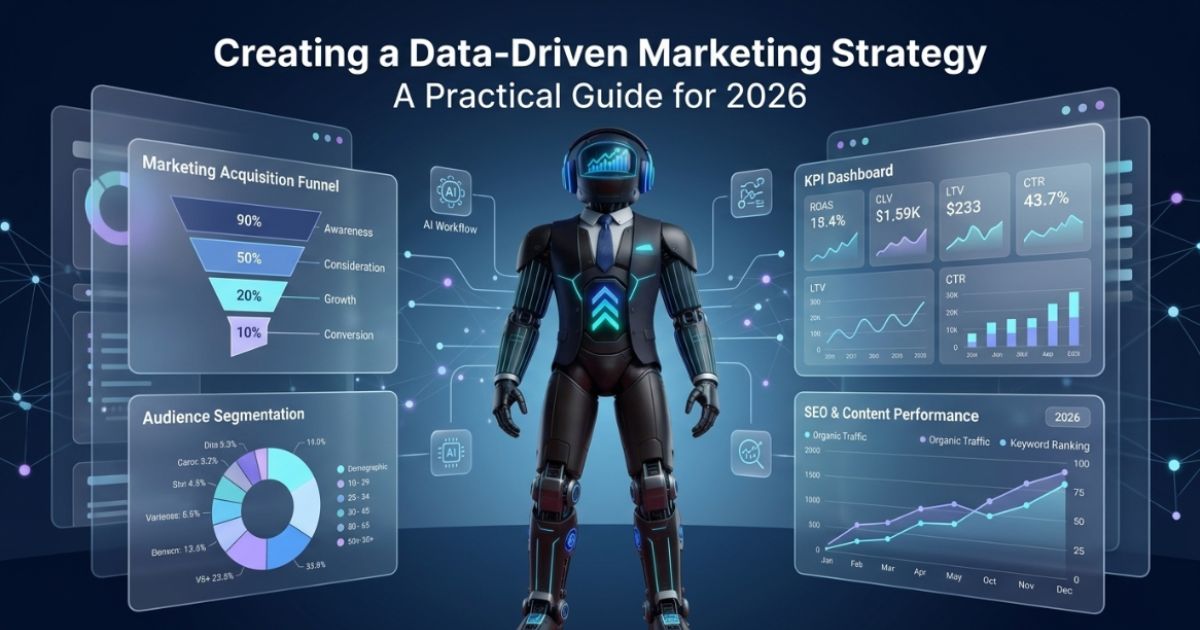
Marketing has quietly become one of the hardest jobs in business. Acquisition costs keep climbing, customer journeys are scattered across a dozen touchpoints, privacy changes have broken the old tracking playbook, and every founder now wants to see exactly how each rupee (or dollar) turns into revenue. Running on gut instinct alone no longer scales.
That is exactly the gap a data-driven marketing strategy closes. Instead of reacting to disconnected reports after a campaign ends, you use customer signals, channel performance, and business KPIs to decide where to invest, who to target, what to say, and how to measure it — all inside one connected system. This guide walks you through what it is, why it works, and how to build one that actually drives growth.
What Is a Data-Driven Marketing Strategy?
A data-driven marketing strategy is a structured way of using customer data, campaign insights, channel performance, and business KPIs to guide every marketing decision. It answers four questions continuously: who do we target, which channels do we invest in, what message do we send, and how do we know it worked?
The difference from intuition-based marketing is depth. Instead of assuming your audience is "women aged 25–45" and building one campaign for everyone, you separate first-time visitors, cart abandoners, repeat buyers, and high-value customers — then give each group the right message at the right moment.
This matters more than ever. Salesforce reports that 84% of marketers now use first-party data, showing how central owned customer information has become. But collecting data isn't the win. The win is turning that data into clear decisions about targeting, personalization, and spend.
Data-Driven Marketing vs. Traditional Marketing
The core difference is how decisions get made.
Traditional marketing leans on past experience, broad audience assumptions, and fixed campaign plans. Budget gets locked into channels before anyone knows what's actually working. Data-driven marketing flips this: real-time signals and customer behavior guide decisions while campaigns are still live.
Take budget allocation. In a traditional model, you might split spend evenly across search, display, social, and email and hope for the best. In a data-driven model, you watch the numbers — if email drives repeat purchases at a low cost and search captures your highest-intent buyers, you shift money toward what pays back.
The obstacle for most teams is fragmentation. Salesforce found that only 31% of marketers are fully satisfied with their ability to unify customer data sources. When your data lives in silos, targeting gets fuzzy, personalization gets weak, and measurement gets untrustworthy. A data-driven approach fixes this by connecting the pieces into one operating model.
The 5 Core Components
A real strategy isn't one dashboard or one campaign report. It rests on five connected components.
1. Data Collection
Everything starts with reliable, unified, compliant data. First-party data — website visits, CRM records, purchase history, email engagement — is usually the most valuable because it comes straight from your own customers. Second-party data comes from trusted partners; third-party data adds broader market context.
The goal isn't more data, it's unified data. If purchase data sits in your store, loyalty data in your CRM, and campaign data in ad platforms, every team sees only a slice of the customer. A unified foundation lets you see the whole person — especially important as privacy rules and signal loss reshape digital advertising.
2. Customer Segmentation & Audience Modeling
Once collected, data becomes useful audience segments. Good segmentation goes beyond age and location into behavior, intent, and predicted value. A SaaS company might segment by trial activity and likelihood to upgrade. An e-commerce brand might separate cart abandoners, discount-sensitive shoppers, and high-LTV loyalists.
Audience modeling helps you prioritize. Rather than treating every lead equally, you focus budget on high-intent users, lookalikes, and segments with real revenue potential — improving accuracy and cutting waste.
3. Channel & Media Strategy
A data-driven channel strategy assigns each channel a job based on how it actually contributes. Paid search captures high-intent demand, display supports retargeting, connected TV builds recall, email drives lifecycle engagement. You don't force every channel to do the same thing — you fund each one according to its real role in the journey, and you stay flexible enough to shift spend when the data changes.
4. Personalization & Content Strategy
Data shapes what you say to each audience. A new visitor needs educational content that frames the problem. A returning visitor wants proof points and comparisons. An existing customer responds to upgrades and cross-sells. The payoff is real: McKinsey found that fast-growing companies generate 40% more of their revenue from personalization than their slower peers. Build a structured content framework around intent and lifecycle stage so personalization scales instead of feeling random.
AI is now a powerful lever in this step. From generating first drafts to mapping content to funnel stages, the right workflow saves hours while keeping output consistent. If you want a practical breakdown of how to plug AI into your content process, read our guide on How to Use AI for Content Marketing — it covers a stage-by-stage workflow you can start using immediately.
5. Measurement, Attribution & KPIs
Measurement connects activity to business results — and you should define your KPIs before launch, not after. Depending on your model, that means customer acquisition cost (CAC), return on ad spend (ROAS), conversion rate, lifetime value (LTV), retention, and revenue contribution. Attribution helps you understand which touchpoints drive conversions, but treat it as a guide, not gospel — pair it with incrementality testing and revenue-based KPIs. The purpose of measurement isn't more reports; it's deciding what to scale, cut, and improve next.
The Benefits
Sharper targeting, less wasted spend. Behavioral signals and intent data let you focus on users likely to act — pricing-page visitors, guide downloaders, repeat sessions — instead of buying broad, cheap impressions that never convert.
Higher conversions and lifetime value. Relevance drives revenue. Matching the message to the customer's stage lifts conversion rates, average order value, and retention all at once.
Faster, smarter decisions. Real-time data means you spot weak segments, tired creative, and inefficient channels while campaigns run — not weeks later. That creates a continuous test-learn-adjust-scale loop.
Marketing–sales alignment. Shared data and shared KPIs — pipeline contribution, qualified opportunities, CAC, LTV — get marketing, sales, and leadership optimizing toward the same goals instead of separate scorecards.
How to Build One That Actually Drives Growth
The secret is sequencing. Do these five steps in order, or your data stays fragmented.
1. Define business objectives and growth levers. Start with outcomes, not vanity metrics. Not "more traffic" — instead lower CAC, higher qualified pipeline, better retention, or expanded revenue from existing accounts. Then pick your lever: acquisition, retention, expansion, or reactivation. A subscription brand with high churn shouldn't only chase signups; it should use data to fix onboarding and renewal.
2. Identify high-value audiences. Not every segment deserves equal investment. Prioritize by intent, conversion likelihood, order value, and retention potential. Discount-driven buyers may convert fast but churn quickly; customers who read product guides may convert slower but stay longer. Data tells you where to put the budget.
3. Align data signals with the customer journey. Map signals to each stage. Awareness: content views and video engagement. Consideration: comparison pages, guide downloads, repeat sessions. Conversion: cart activity, demo requests, pricing visits. Post-purchase: onboarding, repeat orders, renewal risk. This turns scattered interactions into a clear progression you can act on.
4. Design channel and investment strategy. Give every channel a defined role and allocate budget by expected return, not habit. If a channel produces cheap leads but weak pipeline, don't keep funding it just because cost-per-lead looks good. Optimize around business contribution.
5. Build a personalization framework. Define your core segments, message rules, content variations, and success metrics before campaigns go live. A pricing-page visitor shouldn't get the same message as a first-time reader; a dormant customer needs reactivation, not an acquisition offer. This keeps personalization consistent across channels.
Common Mistakes to Avoid
- Treating data as reporting, not strategy. A dashboard showing clicks and conversions changes nothing until it changes what you do next. Connect every report to a decision: scale, pause, test, or fix.
- Buying tools before building a strategy. A CDP or attribution platform won't save you if you haven't defined priority segments and success metrics. Strategy first, tools second.
- Fragmented data and siloed teams. When CRM, analytics, ad, and sales data live apart, you decide on incomplete information. Notably, Gartner found 59% of organizations don't measure data quality — so integration must include validation and ownership.
- Misaligned KPIs. If marketing chases lead volume while sales cares about quality, a "successful" cheap-lead campaign can still fail the business. Align KPIs across the full funnel.
- Ignoring data quality and governance. Duplicate records, inconsistent tracking, and missing consent signals lead to flawed decisions. Good governance makes scaling safer, not slower.
Best Practices for Scaling
Once the foundation works, scale it deliberately. Centralize first-party data so it's usable across targeting and measurement. Use AI to speed up planning and optimization — pattern detection, forecasting, budget recommendations — but keep humans in the loop to protect brand fit and long-term quality. Judge media by business outcomes (pipeline, CAC, LTV, incremental revenue), not platform vanity metrics. And build continuous testing into your operating model, running structured experiments on audiences, creative, and offers so the system improves over time.
Choosing the right stack matters as much as the strategy itself. Not every tool deserves a seat at the table — you need platforms that connect to your data, activate audiences, and report on business outcomes. For a curated breakdown of what's worth using, check out our roundup of the best AI Marketing Tools that actually move the needle for growth teams.
Conclusion: Data as Your Advantage
A strong data-driven marketing strategy isn't built by hoarding data. It's built by using data to make better decisions across targeting, spend, personalization, and measurement. When customer signals, audience insight, AI, and performance metrics work together, marketing becomes more precise, more efficient, and genuinely accountable to growth.
The takeaway is simple: data should guide strategy, not just fill reports. Prioritize high-value audiences, let channel data drive investment, build personalization that scales, and connect every campaign to CAC, LTV, pipeline, and revenue. Treat it as an ongoing operating model — not a one-time setup — and data stops being a cost center and becomes your sharpest competitive edge.